Every California seller learns the same lesson eventually: the state's disclosure law is built around what you already know. Civil Code 1102 asks you to tell buyers about defects you're aware of. It does not require you to go looking for problems, and it certainly doesn't require you to fix anything before you hand over the keys.
San Mateo has one rule that breaks that pattern entirely, and it catches sellers off guard for exactly that reason. It isn't a form you fill out from memory. It's a physical test a licensed contractor runs on your property, and if the pipe fails, you cannot close escrow until it's repaired or replaced. No amount of honest paperwork substitutes for it.
This Isn't a Box You Check. It's a Test You Pass or Fail
Most of what goes on a Transfer Disclosure Statement is a seller reporting on their own knowledge. Roof leak you've seen? Disclose it. Foundation crack you noticed last winter? Disclose it. The standard is honesty about what you know, not an obligation to hire someone to search for problems you don't.
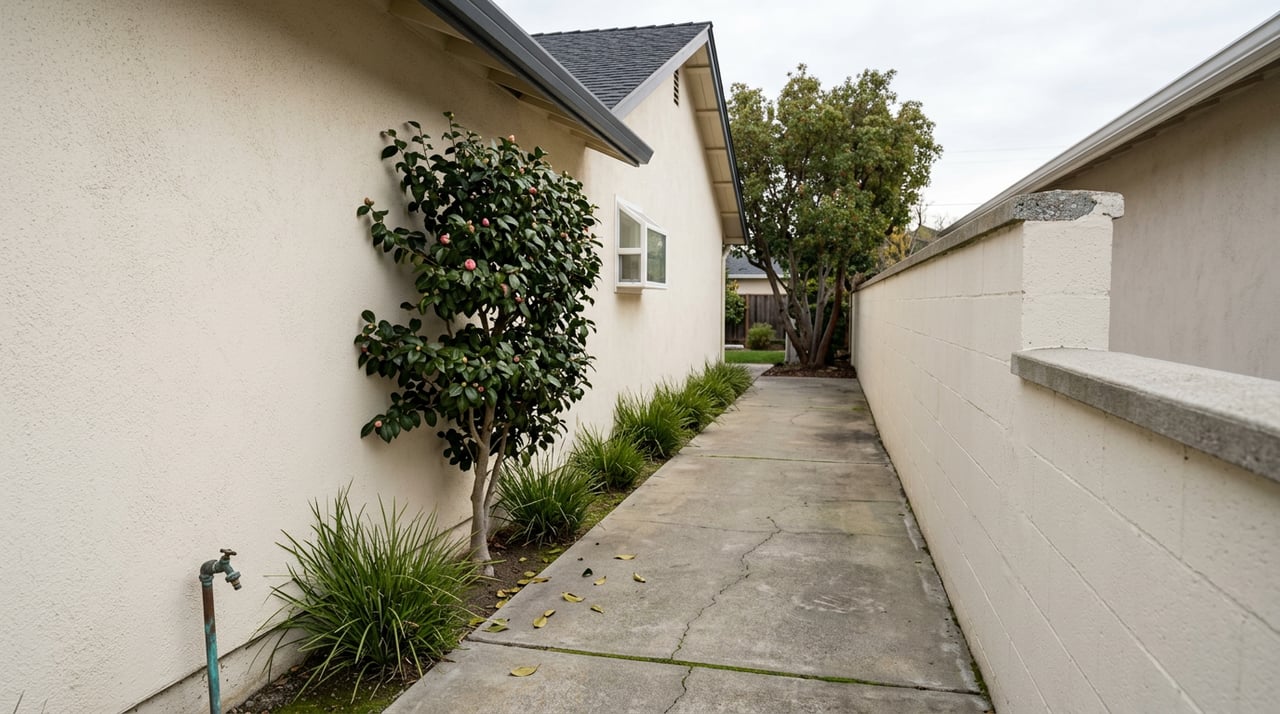
San Mateo's Private Sewer Lateral Ordinance, part of the city's municipal code, works differently. Selling a detached single-family home or duplex triggers a mandatory inspection, performed by a licensed plumbing contractor, before the sale can close. You don't get to say you weren't aware of a cracked pipe running under your side yard. The city makes you find out, on a timeline that isn't yours to control.
The pipe doesn't care what you knew when you listed the house. It only cares whether it passes.
What Actually Triggers the Test, and What Gets You Out of It
The ordinance lists four triggers, but for most sellers only one matters: selling the property itself. The others cover building permits for additions or remodels valued at $90,000 or more, sewer overflows at commercial or multifamily buildings, and changes in sewer customer class. If you're listing a house, the sale trigger is the one that applies to you.
Two exemptions can save you the inspection entirely. If your lateral was already inspected in the past five years and needed no repairs, or needed repairs that were completed, you're covered. If the lateral was fully replaced within the past 25 years and the work received final sign-off through a city permit, you're also covered. Neither exemption is common in practice, which is exactly why so many sellers end up scheduling the test for the first time only after they've accepted an offer.
What "Passing" Actually Means
The city's administrative regulations spell out the standard in specific, almost engineering-grade language. A passing inspection has no pipe section with a structural grade 5 defect and no operational grade 4 or 5 defect, and the sum of every defect grade found in the line has to come in under 13. It's not a subjective call from a contractor. It's a scored report, and the numbers either clear the threshold or they don't.
In practice, the inspection usually means a licensed contractor running a video camera through the line from the house to the city main. If the line fails, the property owner has to repair or replace it before the sale can proceed. There's no partial credit and no waiver available for a seller who simply didn't know the pipe was in that shape.
What This Actually Costs, Compared to What It Could Cost
The test itself is cheap relative to what happens if it fails.
| Item | Typical cost in 2026 | Notes |
|---|---|---|
| Compliance inspection | $300 to $750 | Paid by seller before the sale can close |
| Full lateral replacement | $8,000 to $18,000 | Roughly $150 to $300 per linear foot, all-in with permits |
| City cost-sharing grant | 50% of lowest bid, up to $2,500 | Requires three contractor quotes and city approval before work starts |
The gap between a $500 test and an $18,000 replacement is the entire reason to schedule this early instead of discovering it mid-escrow. A failed test three weeks before a scheduled closing turns a plannable repair into a rush job, and rush pricing on excavation work is real.
The Grant Window That's Already Narrowing
San Mateo runs its own Private Sewer Lateral Cost Sharing Program alongside the ordinance. Any property owner in the city qualifies, regardless of income, and the reimbursement covers 50 percent of the lowest approved bid up to $2,500. It doesn't cover spot repairs, partial replacements, or camera work on its own, only a full lateral replacement with permits pulled.
The catch is timing. Applications for the 2026 cycle opened July 1, and the city reviews submissions on Mondays and Fridays on a strictly first-come, first-served basis until the fund runs dry. Historically, that fund has lasted only a few months once it opens. As of this writing, two months into that window, sellers who are still weighing whether to schedule an inspection are competing against a clock that started before they decided to list.
The Streets Where This Test Bites Hardest
Not every San Mateo property carries the same risk. The neighborhoods most likely to hit a failed inspection are the ones built in the decades right after World War Two, when clay and cast iron piping was standard and nobody was installing a line meant to outlast a century.
- Parkside, built along Marina Lagoon in the 1950s and early 1960s, mostly flat-roofed ranch homes now pushing past 65 years old.
- Baywood Knolls, developed on the former Polhemus Estate in the late 1940s and 1950s, with contemporary post-war construction that's now 70 to 80 years old.
- Westwood Knolls, built out in the 1940s and 1950s once the hilly terrain west of Alameda de las Pulgas was finally graded for construction.
- Foothill Terrace, whose lower-street ranch homes date to the 1950s and follow the same tract-building patterns used across San Mateo's post-war Hillsdale developments.
- San Mateo Village, carrying mid-20th-century housing stock between El Camino Real and the Bayshore Freeway.
None of this means a home in these neighborhoods will automatically fail. It means the pipe material and installation era common to that period are exactly what shows up as cracked clay or deteriorated cast iron on a modern camera inspection, which is the failure pattern contractors report most often on Bay Area lines of this age.
Why This Doesn't Travel With You Across the City Line
Here's the part that trips up sellers and even some agents who've handled transactions in more than one Peninsula city: San Mateo's rule is not universal, and the cities that do have a version of it don't all define it the same way.
San Carlos, Belmont, and Brisbane only require a sewer lateral inspection when a property is remodeled or converted, not automatically at the point of sale. Menlo Park has no point-of-sale requirement at all, since it's served by the West Bay Sanitary District rather than a city program. Redwood City's status is genuinely unsettled as of 2026, with one compliance summary showing no requirement and a separate news report indicating the city adopted one, which means anyone selling there should confirm directly with the city's public works department rather than assume either answer.
Even among the cities that do require a certificate, the method varies. Burlingame requires a witnessed infiltration test where a city representative has to watch it happen, valid for 10 years or 25 years after a full replacement. San Bruno's rule only applies to homes originally built 50 or more years ago. None of that maps cleanly onto San Mateo's four-trigger, scored-defect system. A seller who cleared this process once in a neighboring city should not assume the same steps apply here.
A Practical Timeline for San Mateo Sellers
- Schedule the lateral inspection before you list, not after you've accepted an offer.
- If your property qualifies for the five-year or 25-year exemption, gather the paperwork that proves it now.
- If the line needs replacement, apply for the city's cost-sharing grant immediately, since funding is first-come, first-served and has historically been exhausted within a few months of opening.
- Keep a copy of your inspection report for the buyer's file. The city doesn't issue a separate certificate of compliance for replacements, so the report itself is your proof.
A Few Questions Sellers Ask Us
Does this apply to my condo? No. The ordinance's sale trigger applies specifically to detached one- and two-family dwellings served by a private sewer lateral, not condos or multi-unit buildings sharing a line.
What if my lateral was already replaced a few years ago? If the replacement happened within the past 25 years and received final sign-off through a city permit, you're exempt from a new inspection at sale.
What if I had it tested recently but didn't sell? An inspection within the past five years that showed no repairs needed, or repairs that were subsequently completed, satisfies the requirement without a new test.
San Mateo's sewer lateral rule isn't paperwork you can fill out from memory, and it isn't a disclosure you can shape with careful wording. It's a physical pass or fail sitting between your listing and your closing date, on a subsidy clock that's already running. If you're weighing when to list a San Mateo home built before 1970, that timing question belongs at the top of your plan, not somewhere you discover it in week three of escrow.
The Canlas Brothers walk San Mateo sellers through exactly this kind of local mechanic before it becomes a closing delay. Schedule your free Home Strategy Consultation and we'll map out what your specific property and neighborhood are actually facing.