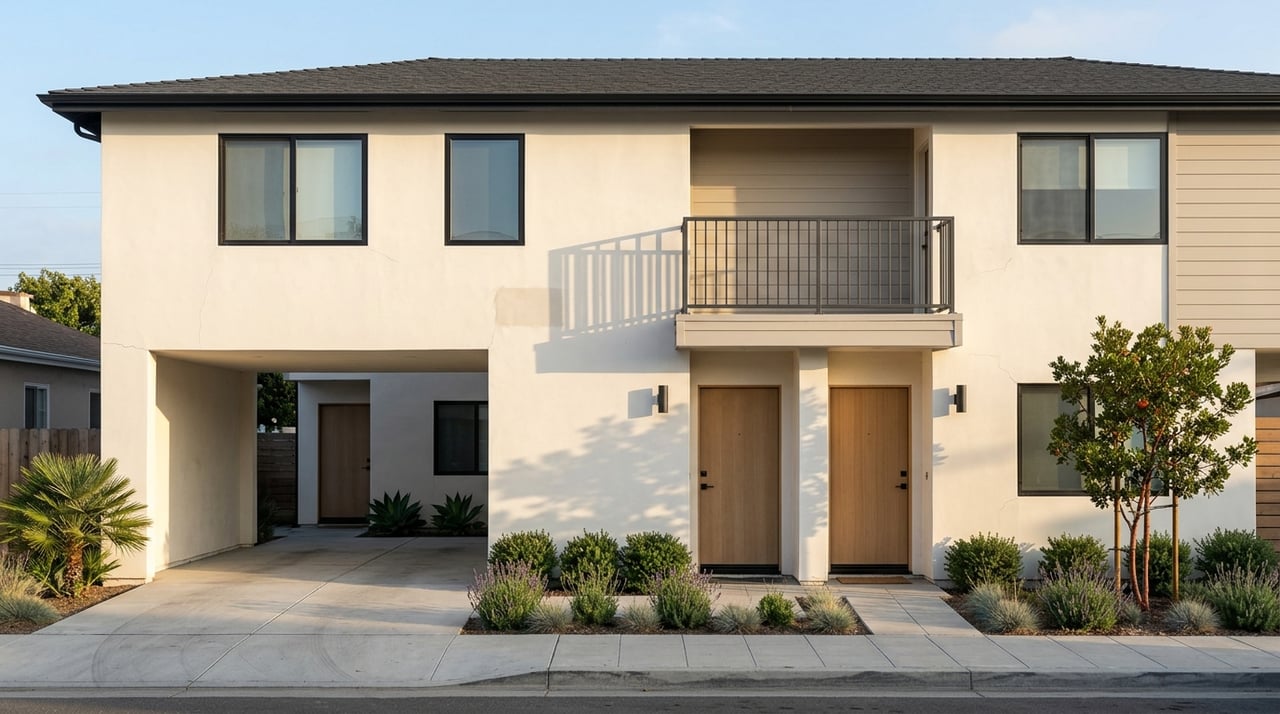
Trying to buy in San Mateo without stretching your budget to the limit? In a market where home values and rents are both high, small multifamily properties and house hacking can offer a more practical path to ownership and long-term wealth building. If you are exploring ways to offset your housing costs, this guide will walk you through the most relevant opportunities, rules, and due diligence points in San Mateo. Let’s dive in.
Why House Hacking Matters in San Mateo
San Mateo is not a low-cost market, and that shapes how buyers need to think. According to the U.S. Census QuickFacts for San Mateo, the city’s median owner-occupied home value is $1,618,700, while median gross rent is $3,077.
That gap is exactly why house hacking gets so much attention here. If you can create or buy a property with income potential, that rent may help offset your monthly ownership costs. The exact numbers will always depend on financing, taxes, insurance, and maintenance, but in San Mateo, rental income can make a meaningful difference in affordability.
What Counts as Small Multifamily
Small multifamily usually means a duplex, triplex, or fourplex. These properties may feel specialized when you first start looking, but they are actually a standard housing type.
Fannie Mae notes that 2-4 unit buildings make up about 7% of homes and one out of six rental units. That is important because it reframes small multifamily as a conventional ownership and investment path, not a niche strategy reserved for professional landlords.
Best House Hacking Options in San Mateo
Buy a duplex, triplex, or fourplex
The classic house hack is still one of the strongest. You live in one unit and rent out the others.
In San Mateo, this strategy fits well with the city’s existing zoning framework for smaller residential income properties. It can work especially well for buyers who want to start building equity while reducing out-of-pocket housing costs.
Add an ADU to a single-family home
For many buyers, an accessory dwelling unit can be the most approachable entry point. San Mateo states that a compliant ADU or JADU can be approved ministerially, which means it needs a building permit and related permits, not a separate planning application or public notification.
That matters because lower-friction approval can make the process feel much more manageable. In practical terms, you may be able to buy a home, live in the main house, and create rental income through an attached, detached, or converted ADU.
Consider a JADU where eligible
A junior accessory dwelling unit is a more specific option. Under San Mateo’s code, a JADU is limited to single-family lots or structures, cannot be placed in a multifamily structure, and is capped at 500 square feet.
A JADU also does not require additional off-street parking. If your goal is modest extra income or a flexible living setup, this can be worth exploring, especially when a full detached ADU is not the best fit for the site.
Explore SB 9 on qualifying parcels
SB 9 is another possible path, but it is not the same as a simple duplex conversion. San Mateo’s local SB 9 overlay rules allow ministerial approval of certain projects with up to two residential units on single-family-zoned parcels and certain lot splits.
However, eligibility is narrower than many buyers expect. For example, the city says qualifying parcels must be in single-family zones and cannot involve recent tenant-occupied housing removals or properties withdrawn from the rent-controlled market within the past 15 years. For urban lot splits, one owner must also sign an affidavit agreeing to occupy one of the units as a principal residence for at least three years.
Zoning Areas to Watch in San Mateo
R2 zoning
San Mateo’s R2 district is explicitly a two-family district, and two-family dwellings are allowed there by right. If you are targeting a duplex strategy, this is one of the most straightforward zoning categories to understand.
For buyers, that can simplify the search. Instead of forcing a property into a use it was not designed for, you are looking within a district that already supports the intended use.
R3 and R4 zoning
The R3 district allows multiple-family dwellings by right, subject to applicable code and objective standards. The R4 district and parts of the C2 district are also relevant for higher-density multifamily or residential mixed-use opportunities.
That opens the door to more than just the traditional duplex search. Depending on the site, some corridor or mixed-use properties may also deserve a closer look if you are analyzing small apartment or house-hack potential.
Why Site Analysis Is So Important
In San Mateo, the opportunity is often highly property-specific. Parking, lot size, building layout, and transit access can all affect whether a deal works.
The city’s SB 9 guidance says no off-street parking is required for certain projects within a half-mile walking distance of a major transit stop or a high-quality transit corridor. The guidance identifies Hillsdale, Hayward Park, and San Mateo Caltrain stations as major transit stops, and El Camino Real as a high-quality transit corridor.
San Mateo’s small-lot multifamily design guidelines also highlight factors like street-facing entries, screened parking, open space, and neighborhood compatibility. That means two properties with similar square footage may have very different upside depending on site layout and design constraints.
Financing Options for House Hacking
FHA financing
If you are wondering whether a low-down-payment purchase is possible, the answer is often yes. HUD says FHA-insured mortgages can include 2-4 unit properties and require a 3.5% minimum required investment for qualifying borrowers.
That can make owner-occupied multifamily more accessible than many first-time buyers assume. You still need to qualify for the loan and the property has to meet lender standards, but FHA remains an important option.
Conventional financing
Conventional loans may also work well. Fannie Mae’s 2023 update expanded standard Desktop Underwriter eligibility for qualifying principal-residence 2-4 unit loans up to 95% loan-to-value, or 5% down.
That said, San Mateo’s pricing means you should not assume every deal fits this box. It is important to confirm whether a property falls into conforming, high-balance, or jumbo financing territory before you build your strategy around a specific down payment number.
Local Rules Investors Should Not Ignore
Tenant protections
If you are buying a property with existing tenants or planning a future value-add strategy, local rules matter. San Mateo’s Residential Tenant Protection Program extends no-fault just-cause protections after 11 months of continuous and lawful occupancy and requires relocation assistance for qualifying no-fault evictions.
The ordinance also requires tenant-rights notice in new or renewed tenancies. If a unit is demolished or substantially remodeled, the city also requires notice back to tenants when that unit becomes available again.
Short-term rental limits
Some buyers think of house hacking as Airbnb income, but that is a separate and more restrictive topic. Under San Mateo’s short-term rental rules, ADUs are excluded from short-term rentals, host-absent short-term rentals are capped at 120 days per year, and the city imposes a 14% transient occupancy tax.
In other words, do not underwrite a deal based on short-term rental assumptions unless you have confirmed the property’s legal use and operating limits. For many San Mateo buyers, long-term rental income is the cleaner and safer framework.
How San Mateo’s Housing Policy Affects Opportunity
San Mateo is not standing still on housing. The city’s Housing Element was adopted in May 2024 and certified by HCD in July 2024, and the city says the plan covers a RHNA target of 7,015 new housing units.
The city has also created a Housing Opportunities Overlay District on roughly 40 parcels and adopted Objective Design Standards that allow qualifying multifamily and residential mixed-use projects up to 25 units to be approved by the Zoning Administrator when they meet the standards. For buyers and small investors, that signals an active local policy environment where infill and redevelopment opportunities may continue to matter.
A Practical Approach for Buyers
If you want to house hack in San Mateo, start with a narrow and realistic plan. The strongest opportunities usually fall into one of three categories:
- A duplex, triplex, or fourplex where you occupy one unit
- A single-family home with ADU or JADU potential
- A qualifying single-family parcel where SB 9 may apply
From there, look at the details that can change the math fast:
- Zoning and allowed use
- Transit proximity and parking requirements
- Financing type and loan limits
- Existing tenant status and local protections
- Site layout, open space, and design compatibility
- Whether your income strategy depends on long-term or short-term rental rules
In a market as expensive as San Mateo, strategy matters more than guesswork. The right property can create flexibility and long-term upside, but the wrong assumptions can get expensive quickly.
If you are weighing a duplex, an ADU property, or an SB 9 opportunity in San Mateo, working with a team that understands Bay Area underwriting, zoning context, and property-specific risk can save you time and help you make a more confident move. If you want help evaluating your options, connect with The Canlas Brothers.
FAQs
Can I buy a duplex in San Mateo with a low down payment?
- Yes. FHA financing can be used for qualifying owner-occupied 2-4 unit properties with a 3.5% minimum required investment, and Fannie Mae allows 5% down on certain qualifying principal-residence 2-4 unit loans under standard DU rules.
Can I add a rental unit to a single-family home in San Mateo?
- Often, yes. San Mateo says compliant ADUs and JADUs are ministerial, and some single-family parcels may also qualify for SB 9.
What zoning supports small multifamily property in San Mateo?
- San Mateo’s R2 district supports two-family dwellings by right, while R3 and R4 allow broader multifamily uses subject to city standards.
Can I use Airbnb income for a house hack in San Mateo?
- You should be careful. San Mateo’s short-term rental rules exclude ADUs, limit host-absent rentals to 120 days per year, and impose a 14% transient occupancy tax.
Why is site analysis so important for San Mateo house hacking?
- Because lot layout, parking, transit access, zoning, and tenant history can all affect whether a property is truly usable for a duplex, ADU, SB 9 project, or small multifamily investment in San Mateo.